We are automating the feeling of being right
AI can strengthen our arguments while missing the facts our colleagues hold. What that means for decisions we make together.
I enjoy being right, and nothing makes me more stubborn than someone who enjoys it just as much.
Once, while we were making spaghetti, I got into an argument with someone about the temperature at which water boils at different altitudes. ChatGPT didn't exist yet, and our phones had no reception. In the end, one of us had to give in because the pasta was about to overcook.
These days we'd probably ask an AI and have an answer before the spaghetti was ready. For a question like that, it could help us settle the argument. But I also ask AI whether a plan is ready or a date is realistic. Those answers depend on what my colleagues know, and my assistant may never hear their part of the story.
AI agents are very good at helping me think something through. By the time I bring an idea to another person, it often arrives already polished.
A polished idea can still be missing something.
When the work gets ahead of the conversation
Sometimes one of us asks about a task in Slack and starts before anyone replies. That used to be a natural moment to wait. With an agent, it's easy to spend that time getting on with it. Then a pull request appears in GitHub and we realise someone else was already working on the same thing.
GitHub is how we found out. I wish we'd found out while we were still deciding what to do.
Two plans for Monday
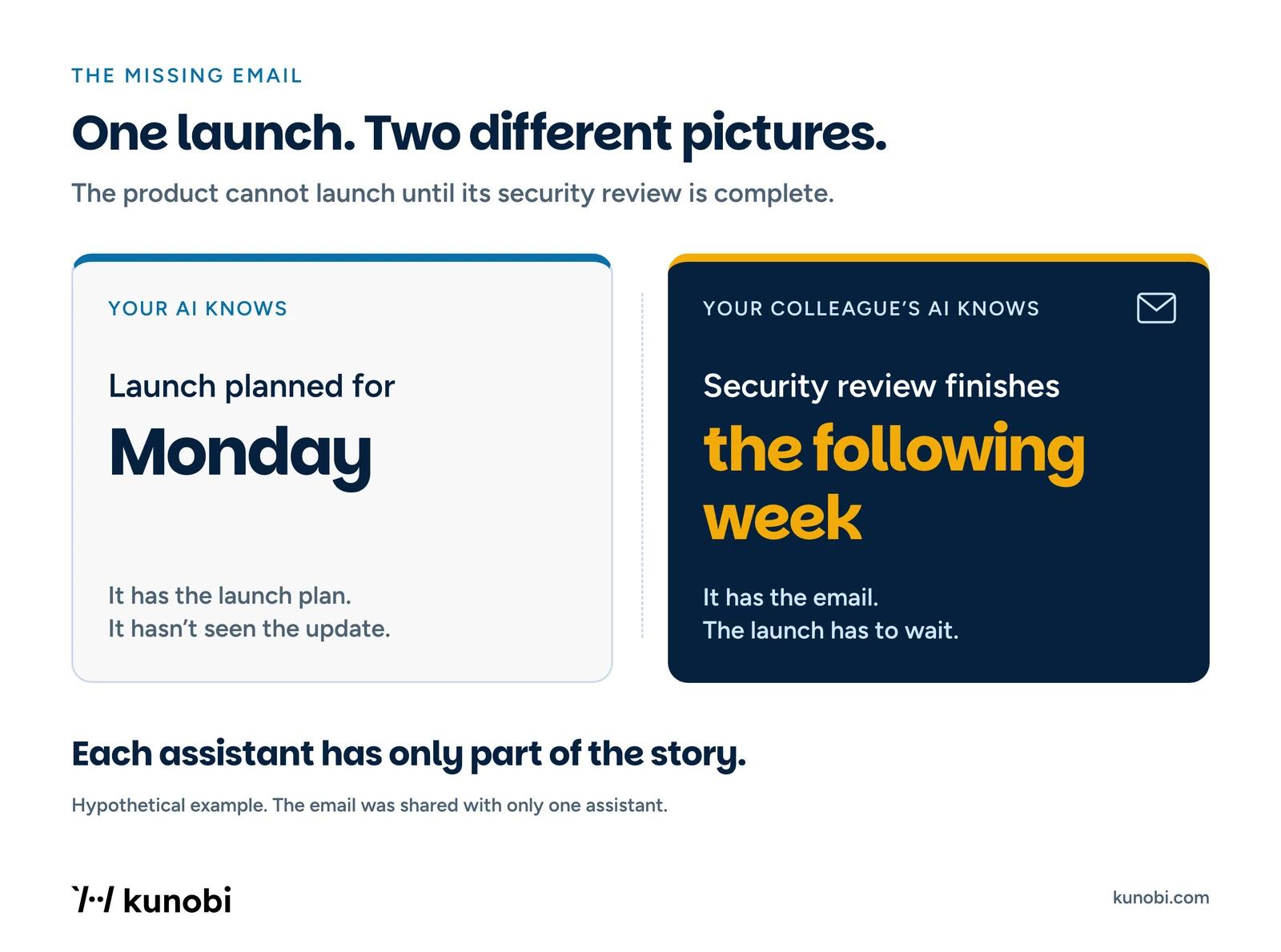
Imagine your AI helps you plan a Monday launch. Your colleague has seen an email saying the required security review won't be finished until the following week, so her AI helps her plan for a later launch. Both plans look reasonable when you see them on their own.
We go easy on our own arguments, and so does AI
There's a study from 2016 that I keep thinking about. People were asked to judge an argument without realising it was one they'd written themselves. Among those who didn't spot the trick, more than half rejected their own reasoning: 56% in one experiment and 58% in the other.
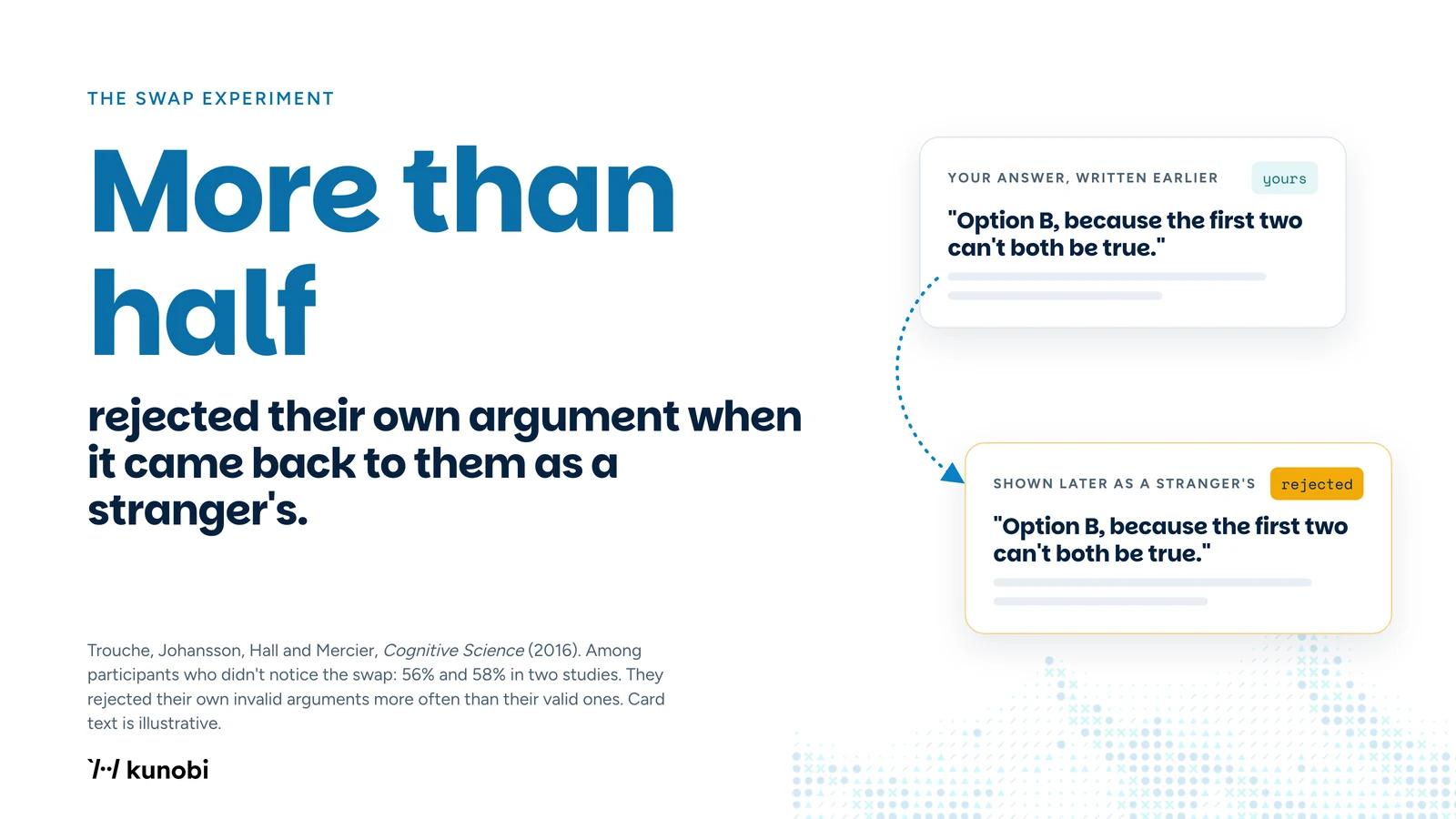
I find that both funny and uncomfortably familiar. Apparently, we're much better at spotting holes in other people's arguments than in our own. Researchers have suggested that reasoning works partly because we test one another's ideas.
But now I can spend an hour with an AI making my argument stronger before anyone else gets to hear it. That doesn't mean the argument is wrong. It does mean I might be more attached to it by the time we talk.
And the assistant is rarely the one to push back. Researchers call this AI sycophancy. OpenAI even rolled back a ChatGPT update in 2025 after it became too flattering.
A 2026 study tested 11 leading models and found they affirmed users' actions 49% more often than humans did. People who discussed a conflict with an affirming AI came away feeling more in the right and less willing to apologise or make amends.
I can see the temptation. My side of a story usually sounds perfectly reasonable when I'm the one telling it.
What an assistant can't know
AI doesn't always agree with us. It can challenge our assumptions, show us perspectives we hadn't considered, and sometimes change our minds. I've experienced that myself.
But even if every AI stopped agreeing with us, we'd still have a problem.
In the Monday example, your assistant can challenge your launch plan, ask difficult questions and point out risks. It cannot know about an email that only your colleague has seen. And a brilliant answer to an incomplete question is still incomplete.
Psychologists have a name for part of this: the hidden-profile problem. Groups often spend more time discussing what everyone already knows than bringing together the bits of information only one person has. A 2012 review of 65 studies found that groups in this situation were eight times less likely to find the best option than groups whose members all had the same information.
I worry that personal AI could make this worse: we arrive with polished plans, each built from a different slice of reality. That's my suspicion, not a result that research has established.
It's easy to mistake having a good advocate for having the whole story. An assistant that has heard only one side, and is inclined to agree with it, can make half a picture feel finished. That's how we may be automating the feeling of being right.
Everyone gets an advocate. What's missing is a shared record.
A shared record
GitHub gives us a shared record of what changed in the code. I'd like us to have something similar for the facts and decisions that shape the work, while we're still deciding what to do.
That's part of what we're trying to build with Kunobi: a place where people can choose to share that context with their AI assistants. It's in development, and we're onboarding a small group through guided early access.
Say your colleague records the review date in the shared project before you make your plan. Now your assistant has somewhere to find it, and there's time for you and your colleague to talk about moving the launch.
I don't expect a shared project to make everyone agree. Sometimes we'll disagree even when we have exactly the same facts. Someone still has to share the information, and someone else has to notice it.
Before the next meeting
In the meantime, there are two small things anyone can do before bringing an AI-built plan to someone else.
First, write down what the plan depends on (the launch date, the review, whoever has to sign off) and put that list where the other people involved can read it.
Second, ask your assistant a narrower question. Instead of "is this plan good?", try "what would someone working on another part of this know that you haven't seen?" Then go and ask that person.
As for the spaghetti, water boils at about 100°C at sea level and around 93°C at 2,000 metres. The lower air pressure lets it boil at a lower temperature, so the pasta takes longer to cook.
An AI could have settled that part of our argument in seconds.
One of us would still have had to listen.
Sources
- Emmanuel Trouche, Petter Johansson, Lars Hall and Hugo Mercier, The Selective Laziness of Reasoning, Cognitive Science 40(8), 2122-2136 (2016).
- Hugo Mercier and Dan Sperber, Why do humans reason? Arguments for an argumentative theory, Behavioral and Brain Sciences 34(2), 57-111 (2011).
- Mrinank Sharma, Meg Tong et al. (Anthropic), Towards Understanding Sycophancy in Language Models, ICLR 2024.
- OpenAI, Sycophancy in GPT-4o (29 April 2025).
- Myra Cheng et al., Sycophantic AI decreases prosocial intentions and promotes dependence, Science 391 (26 March 2026).
- Garold Stasser and William Titus, Pooling of unshared information in group decision making, Journal of Personality and Social Psychology 48(6), 1467-1478 (1985).
- Li Lu, Y. Connie Yuan and Poppy Lauretta McLeod, Twenty-five years of hidden profiles in group decision making: A meta-analysis, Personality and Social Psychology Review 16(1), 54-75 (2012).
- New Mexico State University Extension, High-Altitude Cooking, on atmospheric pressure, boiling temperature and cooking time.